She attended classes. She filled out her exam forms. She took all her first-semester exams. And for months, no one in the English Department at the Islamic University seemed to notice that, according to the university’s own records, she wasn’t listed as a student.
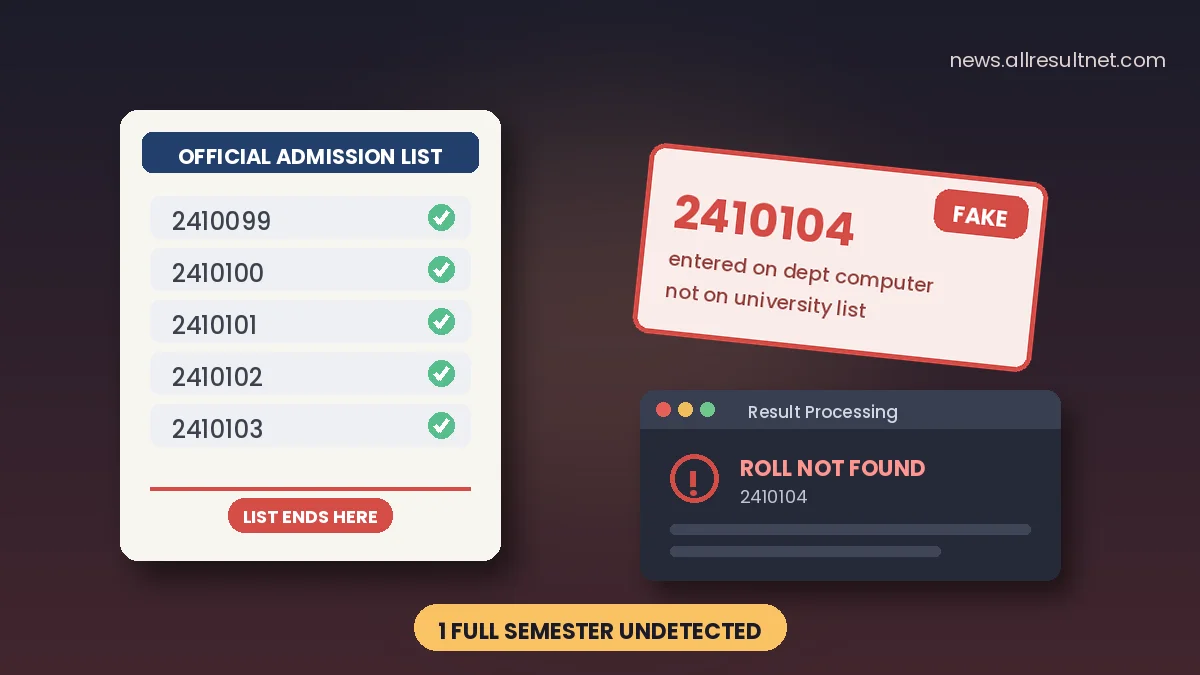
This extraordinary case came to light at the Islamic University (IU) of Kushtia, where admissions fraud was discovered in the English Department only when exam results were being processed and the accused student’s registration number was missing from the university’s computer system.
How the Fraud Worked
According to the account published by Daily Inqilab, the accused — Shamima Akter, listed under roll 2410104 of the 2024-25 academic year — was admitted through fraudulent means and then completed a full semester of classes and examinations as a seemingly ordinary student.
She attended classes. She filled out her exam forms. She took all her first-semester exams. And for months, no one in the English Department at the Islamic University seemed to notice that, according to the university’s own records, she wasn’t listed as a student.
This extraordinary case came to light at the Islamic University (IU) of Kushtia, where admissions fraud was discovered in the English Department only when exam results were being processed and the accused student’s registration number was missing from the university’s computer system.
What the Department Did — And Didn’t Do
The examining committee met on July 11 following the discovery and informed the department head, who convened an emergency meeting that same day.
At that meeting, finding no documentation related to the accused’s admission in either the department or faculty records, the department decided to recommend the cancellation of her exams. It also decided to instruct the relevant department staff to perform their duties more diligently and to reprimand two officials: Assistant Secretary Israt Jahan and Assistant Librarian Murad Hossain.
However, the report raises pointed questions about what the department failed to do. It notes that the department never sent a formal letter to the Examinations Controller or the faculty to verify the student’s information, instead relying on an informal check conducted by department staff. Furthermore, it observes that, in such a serious and sensitive matter, the department held meetings and made decisions without informing the university administration, something many at the university find difficult to explain.
Two weeks passed before the matter became public. According to the report, during that time no investigative committee was formed, nor were any measures taken against those responsible, leading to fears among faculty and students that the fraud network operating behind the case would evade justice. Allegations have emerged that a significant fraud network is operating, aided by certain individuals connected to the department, both within and outside the country, and that the department failed to take any action under pressure from these individuals.
What Those Involved Say
Dr. Mamunur Rahman, chairman of the examinations committee, stated that once the issue was reported in writing to the head of department, the latter convened an emergency meeting and reached a decision after a collective discussion. When asked whether the administrative offices had been informed, he replied that the department had been notified and that, on July 26, another emergency meeting was held with the head of department and tenured professors, at which it was decided to inform the vice-rector.
That Sunday meeting also decided to seek clear written statements from the two officials concerned regarding what had happened.
Murad Hossain, the assistant librarian, said he received a letter at the very end of office hours, left it at the office and had not read it carefully — describing it as carrying a warning message in the heading and, further down, a few lines about performing such work carefully in future.
Israt Jahan, the academic undersecretary, offered a more detailed explanation. She explained that the accused student came to her accompanied by a friend, saying that she had been attending classes for a long time, but that her name was not on the list. When asked if she had been admitted through a quota, the student replied that it was through the veterans’ quota. When Israt Jahan pointed out that she did not appear to meet the requirements for the parental quota, the student claimed that it was her grandfather’s quota and that her student ID number was 2410104. The friend, when questioned, confirmed that the student had been attending classes for a long time. Israt Jahan stated that she never would have imagined being deceived in this way and acknowledged that not verifying the information was her mistake, although she claimed not to know if it should be considered negligence.
The accused student did not answer repeated phone calls. Her husband, Yeasin, also a student in the English Department in the 2023-24 academic year, stated that she had been enjoying her classes from the start and hadn’t told him anything about the admission. He added that when the head of the department summoned her, she admitted her mistake.
Dr. Shahadat Hossain Azad, the head of the department, confirmed that once the examination committee raised the issue, he treated it as a serious matter and called an emergency meeting. At this meeting, the faculty unanimously decided to cancel the accused student’s exams, instruct staff to exercise greater caution, and issue a warning to the two officials involved.
Vice-Chancellor Dr. A K M Matinur Rahman was brief: the university administration will certainly take action after an investigation.
Not the First Time
The report points to a worrying precedent. During the 2019-2020 academic year, fraudulent students were also admitted to the English Department and the Human Resources Management Department. When these cases came to light, the admissions were canceled and the accused left the university; however, the accusation persists that these cases of fraud, for reasons never explained, are concealed at the departmental level through the very networks that enable them.
Precisely because of this history, the two-week silence surrounding this case has unsettled the university community. The cancellation of one student’s exams addresses the symptom. The key question in determining whether anything will truly change is whether anyone can shed light on how a name was entered into the department’s computer system with a registration number that the university never issued, and who benefited from it.
The Bigger Question
Beyond the details, this case highlights a troubling structural deficiency. A student’s enrollment appears to have been accepted at the departmental level through an informal check, rather than a centrally verified list. This discrepancy persisted throughout an entire semester of classes, forms, and exams before an automated results processing system detected it.
That the software caught what the human process missed is, in a way, reassuring. That it took an entire semester to catch it is not.
We will report on the outcome of the university’s investigation, the actions taken against those responsible, and the administration’s response as this story develops. Stay tuned.